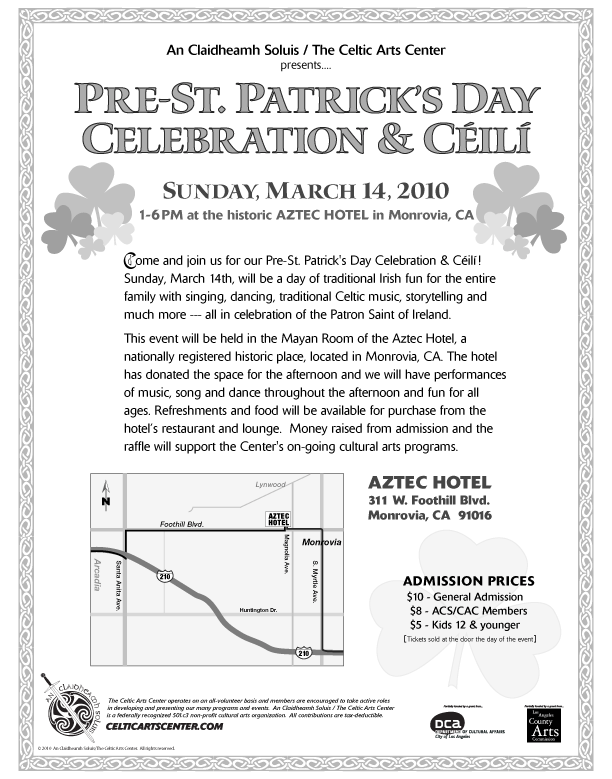
An Claidheamh Soluis/The Celtic Arts Center presents a...
PRE-ST. PATRICK'S DAY CELEBRATION & CÉILÍ
1 - 6PM, SUNDAY, MARCH 14, 2010
held in the Mayan Room at the historic Aztec Hotel
located at 311 W. Foothill Blvd. in Monrovia, CA 91016
An Claidheamh Soluis/The Celtic Arts Center presents a...
PRE-ST. PATRICK'S DAY CELEBRATION & CÉILÍ
1 - 6PM, SUNDAY, MARCH 14, 2010
held in the Mayan Room at the historic Aztec Hotel
located at 311 W. Foothill Blvd. in Monrovia, CA 91016
Every year around St. Patrick's Day, the Celtic Arts Center holds its annual celebration of this day of Irish bonding, and in a spirit that the tolerant Patrick himself might have lauded, it is combined with a nod to the Spring Equinox, which happens around the same time. We honor the occassion with music and dance, food and drink, and merriment. Come and join us for a day of traditional Irish fun for the entire family with singing, dancing, music, storytelling and much more — all in celebration of the Patron Saint of Ireland. This event will be held at the historic Aztec Hotel in Monrovia, CA and they've donated the space for the afternoon. Refreshments and food will be available for purchase from the hotel's restaurant and lounge.
AZTEC HOTEL
311 W. Foothill Blvd.
Monrovia, CA 91016
Admission: $10 General Public, $8 for ACS/CAC Members, and $5 for kids 12 and younger.We plan to have performances of music, song and dance throughout the afternoon and fun for all ages. Money raised from admission and the raffle will support the Center's on-going cultural arts programs.
We hope you'll join us for our Pre-St. Patrick's Day Céilí!
BEANNACHTAÍ NA FÍLE PÁDRAIG ORAIBH!
Who was St. Patrick?As a young boy, Patrick spent the first sixteen years of his life in the comfortable and mundane routine of a child of an upper middle class noble family in Christian Roman Britain. In 401A.D., Celtic raiders swept up the British coast and kidnapped hundreds of people for the slave trade. Patrick, then known as Patricius, was among those captured by the raiding Celts. He was taken to Ireland and sold to Miliucc, one of the many Kings in that country.
Patricius endured six years of slavery herding sheep in the hills of Antrim in the North of Ireland, suffering hunger, cold and the solitary existence of a shepherd. Prior to his capture, Patricius had found little need for the "God" - "Christ" that his parents had worshipped, but in his years of isolation he changed from a careless boy into a holy man, praying to God constantly, and having "visions" in which God spoke to him. Through these "visions", Patricius was able to escape from Ireland and return to his family in Britain. But he found it impossible to fit in with Roman society again, changed as he was from his experiences, and woefully uneducated compared with his peers. He continued to pray to God for direction in his life, and he continued to have visions. In one vision, in a dream, a man he once knew in Ireland held a handful of letters and handed him one. The letter read "VOX HIBERNIONACUM", "the voice of the Irish". At that moment, he heard the voice of a multitude (beside a forest that Patricius remembers as being "near the western sea") crying: "We beg you to come and walk among us once more."1 From that day onward, Patricius continued to have visions calling him back to Ireland.
He traveled to the island monastery of Lerins just offshore from present day Cannes, seeking formal theological education to become ordained in the Roman Catholic Church. After being ordained as first a priest and then a Bishop, he returned to Ireland as a missionary to bring the Catholic faith to the people of Ireland whose voices he had heard calling for so long - no longer Patricius, but Patrick.
Through his efforts, Christianity was introduced to Ireland. Patrick loved and respected the Irish people, and praised and preserved their stories and mythology. This was certainly a factor in the acceptance of the new religion, which was approached more as a melding of the old and new than simply an obliteration of the old. When it is said that St Patrick drove the snakes out of Ireland, it is meant that he drove out the ancient indigenous religious practices that had been observed by the people of that island for thousands of years. The snake was a highly revered symbol of the Goddess, and represented fertility and renewal. The biological fact is that there never were any real snakes in Ireland at all. Driving out the snakes is merely an illustration through symbolism of how Patrick virtually eliminated Pagan Religous practices in Ireland. One interesting thing about this conversion to Christianity is that Ireland is seemingly the only country where Christianity was embraced by the people, and introduced without bloodshed.
Although St. Patrick is revered in Ireland, and has collected a number of improbable legends of his own, it is often noted that St. Patrick's Day is more enthusiastically observed by the children of Irish immigrants in America than in Ireland. As exiles (and often unwelcome ones at that) Irish Americans took St.Patrick's feast day as an occasion to celebrate their culture and unity in the new world.
1 - from "How the Irish Saved Civilization" by Thomas CahillAn Claidheamh Soluis / The Celtic Arts Center
ACS / CAC Homepage